


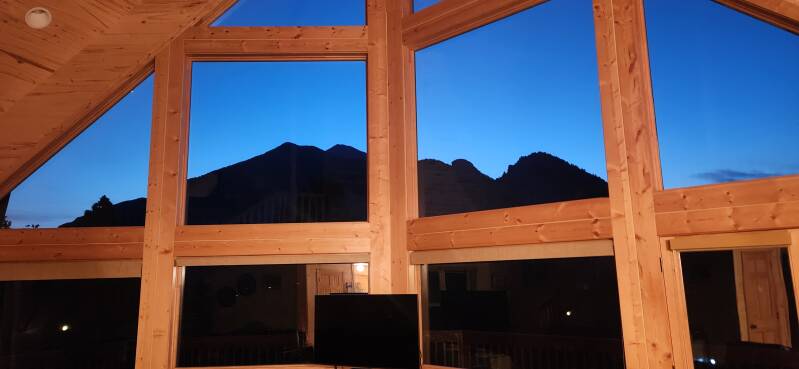
Last November, my family and I were so lucky to, just by chance, experience one of the most epic meteor showers. We spent Thanksgiving at a house rental near Buena Vista, Colorado with floor to ceiling windows overlooking an incredible view of Mt. Princeton. We thought it was the perfect opportunity for stargazing because we could just turn off the lights and literally sit and look the sky from the comfort of the couch. Lucky us, the Leonid meteor shower was in full swing and we had the most amazing evening watching all the shooting stars!
While the Leonids may not produce as many shooting stars as the famous Perseids, they have a fascinating history of putting on some of the most spectacular shows ever recorded. The Leonids are especially interesting because they occasionally produce something far more dramatic than an ordinary meteor shower: a meteor storm, with thousands of meteors streaking across the sky in a single hour!

What Causes the Leonid Meteor Shower?
Like most meteor showers, the Leonids originate from a comet. In this case, the source is Comet 55P/Tempel–Tuttle, which takes approximately 33 years to complete one orbit around the Sun.
Comets are made of ice, dust, and rocky material. As a comet approaches the Sun, its ice warms and releases gas and dust, leaving behind a trail of debris along its orbit. When Earth passes through this debris, tiny particles called meteoroids enter our atmosphere at tremendous speeds. The particles collide with air molecules, heating the surrounding gas and producing the bright streaks of light we call meteors or shooting stars.
If your young astronomers are curious about the differences between comets, asteroids, meteors, and meteorites, check out our Inspiring Young Astronomers with the Perseids article, which includes a free anchor chart and coloring pages!

What Makes the Leonids Special?
They're incredibly fast
The Leonids are among the fastest meteors we can observe, entering Earth's atmosphere at approximately 44 miles (71 kilometers) per second. That's more than 150,000 miles per hour! At that speed, a meteor could travel from New York City to Los Angeles in less than a minute.
Their incredible speed often produces bright, colorful streaks across the night sky. Some Leonid meteors even leave behind glowing trails, called persistent trains, that remain visible for several seconds or longer after the meteor has disappeared.
They have a history of spectacular meteor storms
Most years, the Leonids produce a relatively modest display, with around 10–15 meteors per hour under ideal conditions. However, the Leonids are famous for occasionally producing meteor storms. During a meteor storm, Earth passes through an unusually dense concentration of comet debris, producing hundreds or even thousands of meteors per hour.
One of the most extraordinary Leonid storms occurred in 1833, when observers across eastern North America witnessed an astonishing number of shooting stars. Some historical estimates suggest that tens of thousands of meteors were visible per hour! Many people described the sky as looking like falling rain or snow, except that the streaks were made of light.
Another spectacular storm occurred in 1966, when observers in parts of the southwestern United States reported thousands of meteors per minute during the storm's brief peak. These extraordinary events helped scientists better understand the relationship between comets and meteor showers.
They remind us that space is constantly changing
Although the Leonids return every November, the number of visible meteors varies from year to year. The debris left behind by Comet Tempel–Tuttle isn't distributed evenly throughout its orbit. Some regions contain much denser concentrations of particles than others. Scientists study the comet's orbit and the movement of its debris trails to predict when Earth might encounter these concentrations Can scientists predict the next Leonid meteor storm? Surprisingly, yes, but with limitations. In fact, many years ago, my husband did a research project at Los Alamos National Laboratory’s Computational Physics department on meteors and there are many scientists studying them!
Astronomers use computer models to track the trails of dust and debris left behind by Comet Tempel–Tuttle. By calculating when Earth might pass through especially dense regions of these trails, scientists can predict periods of unusually intense meteor activity. The comet will return to the inner solar system in 2031, and some models suggest that the Leonids could produce spectacular displays in 2033 or 2034, potentially reaching more than 1,000 meteors per hour! Other predictions are more cautious, so a meteor storm isn't guaranteed. For now, we'll have to keep watching the skies to see whether the Leonids put on another extraordinary show.

When and Where Can You See the Leonids?
In 2026, the Leonids are expected to peak around November 17–18, with up to approximately 15 meteors per hour under ideal viewing conditions. The best opportunities to see them will be during the early morning hours, after midnight and before sunrise, when the Moon has set and the sky is darkest.
The Leonids get their name from the constellation Leo the Lion, because the meteors appear to radiate outward from that region of the sky. However, you don't need to find Leo to enjoy the shower. Meteors can appear anywhere overhead, so looking at a broad area of the sky is your best strategy.
For the best viewing experience, find a location away from city lights. We just serendipitously stumbled upon our location in Buena Vista, Colorado. Allow your eyes 20–30 minutes to adjust to the darkness, if you must use lights, red lights allow your eyes to adjust to the dark more quickly. Keep mind that you don't have to stay up late to see shooting stars. Observing the sky before dawn is also a great time to view meteors. Finally, if you aren’t lucky enough to see the shower from the comfort of your couch like we were, bring warm blankets or sleeping bags. November nights/mornings can be chilly!
You won't need a telescope or binoculars. In fact, meteor showers are best observed with the naked eye because you can see a much larger portion of the sky.

Turn Meteor Watching into a Science Investigation!
Watching a meteor shower is an excellent opportunity to introduce children to astronomy, observation, and data collection. Encourage your young scientists to become meteor researchers by keeping a meteor observation journal. Record the date, time, location, weather conditions, and number of meteors observed during a set period, such as 15 or 30 minutes.
For each meteor, try recording its brightness, color, direction of travel, and whether it left behind a glowing trail. Afterward, challenge your young astronomers to analyze their observations. Did they see more meteors during certain time intervals? Were some brighter than others? Did the meteors appear to travel in similar directions?
You can even compare observations from different nights or meteor showers throughout the year to investigate how meteor activity changes over time.
For an additional challenge, have students calculate the average number of meteors observed per hour and compare their results with published meteor shower predictions. Discuss why their observations might differ from the predicted rates.
Free Download!

The Leonids remind us that some of the most fascinating scientific discoveries begin by simply looking up. Whether you spot one shooting star or several, each meteor provides a glimpse into the history of our solar system. Those tiny particles have traveled through space for years, sometimes centuries, before finally encountering Earth's atmosphere.
So bundle up, head outside, and encourage your young astronomers to explore the night sky. If you aren't able to view the Leonids in person, you can still learn about meteors, asteroids, and comets with this printable activity!
