

The Science of Snow: Chemistry, Crystals, and Winter Wonder
We are mid-December here in Colorado and have only had ONE snowstorm so far. My kids are anxiously awaiting the soft, quiet, sparkling, and endlessly fun fluff to fall from the sky. While we wait for snow to come, I thought it would be fun to dive into the science of snow because behind every snowflake is a beautiful mix of chemistry, physics, and chance. From their six-sided symmetry to their dazzling whiteness, snowflakes offer an incredible opportunity to explore how science shows up in everyday life.
Why Do Snowflakes Always Have Six Sides?
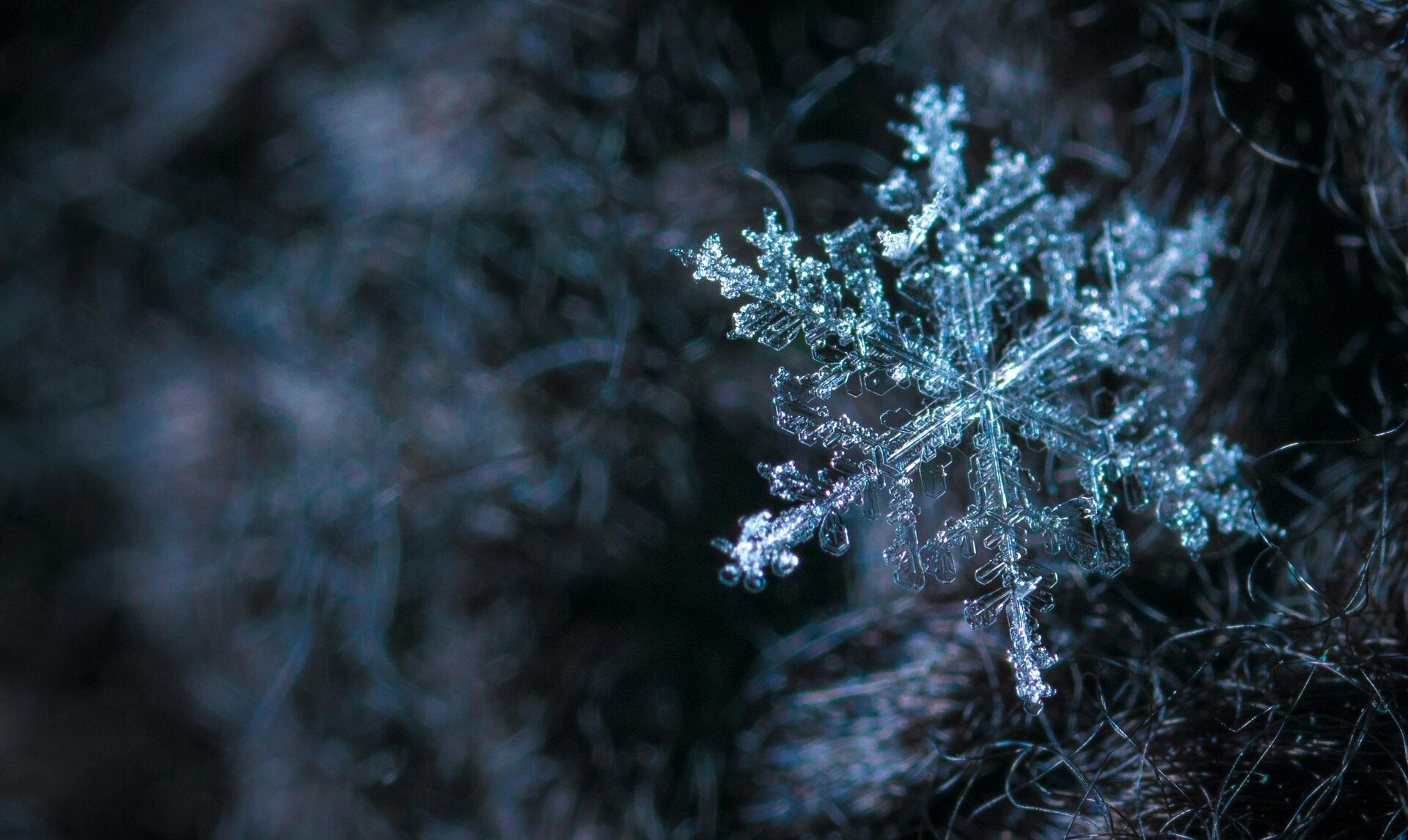
One of the most famous facts about snowflakes is that they all have six sides. This isn’t coincidence, it’s actually chemistry. Snowflakes are made of water molecules (H₂O). When water freezes into ice, the molecules arrange themselves in a specific geometric pattern. Each water molecule bonds to others at angles that naturally form a hexagonal (six-sided) structure. This molecular arrangement happens no matter where the snowflake forms—high in a cloud or gently falling to the ground.
So while snowflakes can grow into many different shapes like plates, columns, needles, or branching stars, which I’ll discuss in more detail below, the underlying structure is always based on sixfold symmetry. It’s a wonderful example of how microscopic chemistry shapes what we see at a macroscopic scale.

How Do Snowflakes Form?
Snowflakes begin their journey high in cold clouds, where temperatures are below freezing and tiny particles of dust or pollen float in the air. These particles act as nucleation sites, giving water vapor something to cling to as it freezes. Instead of turning into liquid water first, the vapor undergoes a process called deposition, changing directly from a gas into solid ice. As more water vapor freezes onto the growing crystal, the snowflake increases in size. The exact shape the snowflake develops depends on the temperature and humidity of the air, how quickly the crystal grows, and how it moves through the cloud as it falls. Even very small changes in these conditions can dramatically affect the final shape, leading to branches, ridges, or delicate patterns that make each snowflake look different.

Different Types of Snowflakes: A Snow Crystal Menagerie
Not all snowflakes look like the classic lacy star you draw in December. Snow crystal scientists have spent decades observing real crystals under magnification and developed classification systems to describe the many forms that ice crystals can take as they fall from the sky. The online project of snow researcher Kenneth Libbrecht (snowcrystals.com) points out that in nature snowflakes appear in a wide variety of shapes, and scientists have documented dozens of distinct types based on how the ice crystals grow.
Here are some of the major types you might encounter:
Stellar Crystals and Stellar Dendrites
These star-shaped crystals with six arms are the snowflakes most of us picture. When conditions in the cloud are cold and humid, the crystal develops branches that give it its classic lacy look. Larger versions with feathery side-branches are often called fernlike stellar dendrites.
Plates
Plate crystals are flat, thin, and often hexagonal like a simple six-sided pancake. Some have extensions or tiny bumps along the edges. They form in slightly warmer or drier cloud conditions than dendrites.
Columns and Needles
Under a magnifying glass, some crystals look like tiny rods or six-sided columns. These form when the temperature is just right for growth along the crystal’s vertical axis. Needles are especially slender versions of columns. Capped columns are a column with flat plates on one or both ends. They form when snow crystals travel through different layers of temperature and humidity as they fall, switching growth habits mid-flight.
Triangular and Odd Shapes
Although the hexagon is the rule, sometimes aerodynamic influences or growth dynamics create crystals that appear triangular or with uneven branch lengths. These are still rooted in the same six-fold chemistry but shaped by unusual conditions.
Complex and Irregular Forms
Not all snowflakes are perfect. Some crystals get jostled, melted, or bumped in the clouds, resulting in irregular, misshapen, or clustered forms. Others collect tiny droplets that freeze onto them, leading to rimed crystals or soft pellets called graupel.
Why So Many Shapes?
There’s no single “official” number of snowflake types as classification schemes vary. The 1951 International Classification system lists seven basic crystal types, which has expanded into dozens or even dozens of subtypes based on subtle differences in shape and structure. All of these variations come from the fact that snow crystals grow slowly, molecule by molecule, as they move through different temperatures and humidity levels in a cloud. Tiny environmental changes cause the crystal to grow in different directions, making each snowflake a record of its journey through the atmosphere.
Are Snowflakes Really All Unique?
You’ve probably heard the saying that no two snowflakes are alike. Is that actually true??? Well, yes, mostly. There are physical rules that limit how snowflakes can form. Scientists have identified common categories of snowflakes, so in that sense, the number of possible basic structures is limited.
However, the exact path a snowflake takes through a cloud is incredibly complex. Tiny differences in temperature and humidity at each moment of growth affect how water molecules attach to the crystal. Because a snowflake experiences millions of microscopic changes during its formation, the final result is extraordinarily unlikely to be duplicated exactly. So while snowflakes aren’t infinite in theory, in practice, the chances of two being perfectly identical are vanishingly small, especially at the level of detail visible under a microscope.

Why Is Snow White?
Snow is made of clear ice, so why doesn’t it look transparent? The answer lies in light scattering. Individual ice crystals are clear, but snow on the ground is made of millions of tiny crystals with air trapped between them. When sunlight hits snow, it enters the ice, bounces around between crystal surfaces, and reflects back out in all directions. Because all colors of visible light are reflected equally, our eyes perceive the result as white. This same light-scattering effect also explains why different forms of ice and snow can look so different in color. A solid ice cube appears clear because light can pass straight through it with very little scattering. Packed or dirty snow, on the other hand, looks gray because the light is absorbed or blocked by impurities and fewer wavelengths are reflected back to our eyes. Deep snow can even appear blue, especially in snowbanks or glaciers, because light traveling through thick layers of ice loses more of the slow moving red wavelengths, allowing the blue light to dominate

Beyond snowflakes themselves, snow offers countless opportunities to explore fascinating science concepts in meaningful, hands-on ways. Comparing snow, ice, and sleet helps children understand how different temperature layers in the atmosphere affect precipitation. Fresh snow also changes how sound travels by trapping air between ice crystals, which is why snowy landscapes often feel quiet and hushed. Even though it forms in cold conditions, snow acts as a natural insulator, protecting plants and animals underneath by keeping temperatures more stable. In some places, snow can even appear pink, red, or yellow due to cold-loving algae or by dust and pollution carried long distances through the atmosphere.
All of these phenomena make snow a perfect science topic for kids. It connects abstract ideas like molecular structure, energy transfer, and light behavior to something children can see, touch, and experience firsthand. Snow invites careful observation, pattern recognition, and curiosity-driven questions while naturally supporting cross-disciplinary learning in chemistry, physics, and Earth science. For parents and educators, snow is a powerful reminder that science doesn’t always require a lab or special equipment, sometimes, it’s falling quietly right outside your door.
Add comment
Comments