


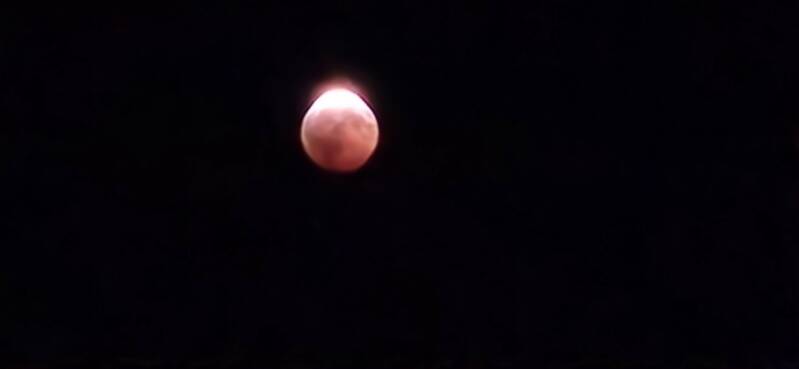
Last week, my family had the chance to watch a lunar eclipse together. We stood outside, looking up as the Moon SLOWLY changed. I'm not going to lie, the experience was a bit underwhelming, but we did get have a great discussion about why a lunar eclipse happens and how so many people have the misconception that the phases of the moon are related to the Earth's shadow.
The Moon is one of the easiest objects in space for children to investigate. You do not need a telescope, complicated equipment, or even a perfectly dark sky. You simply need a place where you can look up, take your time, and notice what is there.
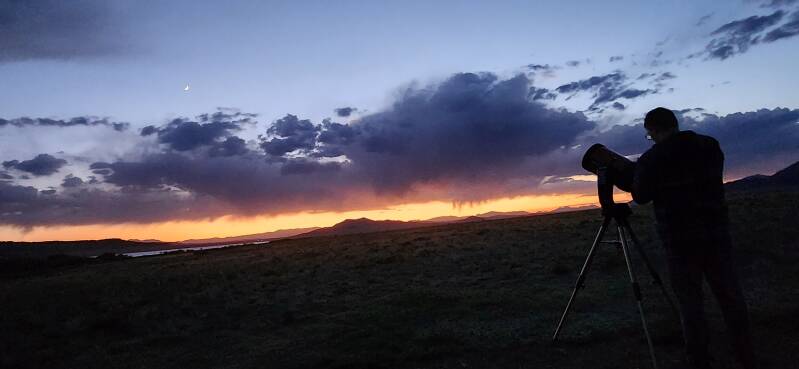
On Saturday, September 19, 2026, people around the world will do exactly that as part of International Observe the Moon Night. Whether your family spends five minutes looking from the backyard or plans an entire evening of Moon-themed activities, it is an opportunity to slow down and examine a familiar object with a scientist’s eyes.
What Is International Observe the Moon Night?
International Observe the Moon Night is an annual celebration of lunar observation, science, exploration, and the many cultural connections people have with the Moon. It is sponsored by NASA’s Lunar Reconnaissance Orbiter mission and the Solar System Exploration Division at NASA’s Goddard Space Flight Center.
People can participate by attending a community event, looking through a telescope, completing a Moon activity, making lunar-inspired art, reading Moon stories, or simply stepping outside and observing. NASA encourages people to interpret the word observe broadly, so participation does not have to involve special equipment or a formal event.
The shared date creates something unusual: families, classrooms, astronomy clubs, museums, and scientists around the world will all be looking toward the same object. Even though observers may be separated by thousands of miles, they will be connected by their curiosity about our nearest celestial neighbor. Cloudy weather does not have to cancel the celebration, either. Families can explore Moon maps, create models, investigate craters, or keep a journal using observations made on nearby evenings.

Why Will the Moon Be Especially Interesting That Evening?
International Observe the Moon Night is not assigned to the same calendar date every year. Organizers select a Saturday in September or October when the Moon is near its first-quarter phase. In 2026, the official celebration falls on September 19.
Despite its name, a first-quarter Moon looks half illuminated from Earth. The word quarter refers to the Moon having completed approximately one-quarter of its orbit around Earth since the new Moon. A first-quarter Moon is especially convenient for families because it is already visible during the afternoon and remains in the sky during the evening. Children do not need to stay up particularly late to participate. I'm very excited about that because my kids and I were a hot mess the morning after staying up late for the lunar eclipse.
The first-quarter moon is also one of the best phases for examining the Moon’s surface. The line separating lunar day from lunar night crosses the middle of the Moon, placing many mountains, valleys, and craters near areas of strong light and shadow. This makes the surface appear much more textured than it does during a full Moon. NASA’s 2026 Moon maps identify maria, landforms, and human landing sites that will be well positioned for viewing on September 19.

What Can Families See Without a Telescope?
A telescope can reveal remarkable details, but it is not required. Begin with your eyes and give them time to adjust. The first thing children will probably notice is the Moon’s overall shape. Ask them to describe how much appears illuminated. Does it look exactly like half a circle? Which side is bright? Where does the light appear to end?
Next, look for the darker gray patches on the Moon. Early astronomers thought these areas might be oceans, so they called them maria, the Latin word for “seas.” They are not filled with water. They are enormous, relatively flat plains made from dark volcanic rock. Long ago, lava flowed into large impact basins and cooled into solid basalt. The lighter areas are older, more heavily cratered lunar highlands. From Earth, the contrast between the light highlands and dark maria creates the familiar patterns that people sometimes call the “Man in the Moon.”
You can also observe:
- The sharp division between the illuminated and dark portions of the Moon
- Irregular bumps and indentations along that dividing line
- Differences between the Moon’s bright and dark regions
- The Moon’s position above the horizon
- Its location relative to nearby buildings, trees, planets, or bright stars
- Changes in its position and appearance over several evenings
Binoculars can reveal additional detail, but children should begin by recording what they can see without magnification. Careful observation is a scientific skill, even when the observer does not know the names of the features yet.

Viewing the Moon's Craters
The boundary between the illuminated and dark sides of the Moon is called the terminator. It marks the division between lunar day and lunar night. Near the terminator, sunlight strikes the Moon’s surface at a low angle. Mountains and crater walls cast long shadows across the ground. These shadows create strong contrast, making differences in the height and shape of the surface easier to see. NASA recommends observing phases other than the full Moon for this reason.
Imagine placing a flashlight directly above a bumpy surface. With the light shining straight down, the bumps may look fairly flat because they cast very short shadows. If you lower the flashlight and shine it from the side, the same bumps cast long shadows and suddenly become much more noticeable.
The same effect occurs on the Moon. Near the terminator, crater rims may appear bright while their floors remain dark. Mountain peaks can sometimes catch sunlight even when the surrounding ground is still in shadow. A full Moon may look brighter and more dramatic, but its surface features can actually be harder to distinguish. At that phase, sunlight strikes the side of the Moon facing Earth more directly. With fewer strong shadows, the landscape can appear flatter.
Encourage children to examine the terminator carefully. Even without a telescope, they may notice that it is not a perfectly smooth line. With binoculars, its rugged edges and shadowed craters become much easier to identify.
Common Misconception: Moon Phases Are Not Caused by Earth’s Shadow
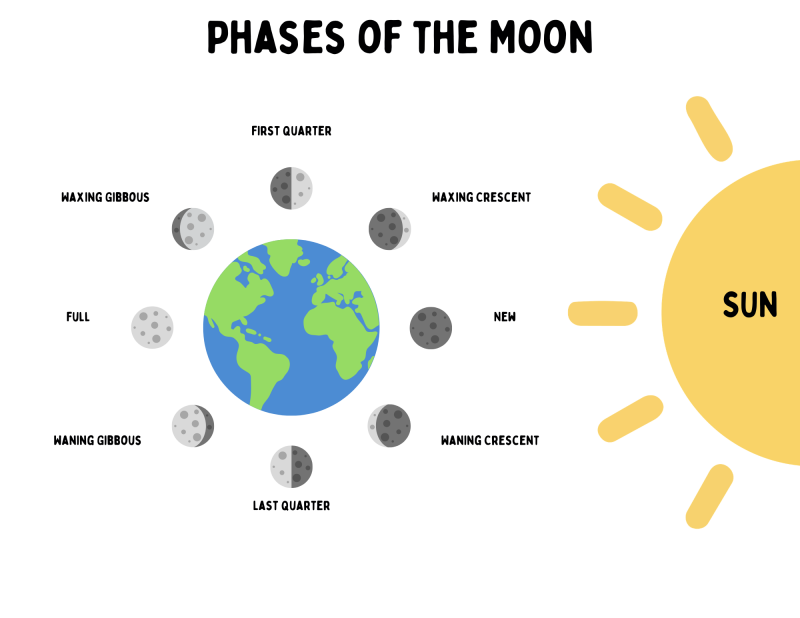
As my family and I watched the lunar eclipse last week, I realized that there was some confusion about Earth's shadow and moon phases. It is easy to understand why many people think Earth’s shadow causes the phases of the Moon. Part of the Moon looks dark, so it seems logical that something must be blocking the light. However, Earth’s shadow is involved only during a lunar eclipse.
The Sun continuously illuminates half of the Moon, just as it illuminates half of Earth. As the Moon orbits Earth, our viewing angle changes. Sometimes we see most of the Moon’s illuminated half. At other times, we see only a small portion of it. These changing views create the phases of the Moon. During a full Moon, the side facing Earth is almost completely illuminated. During a new Moon, the illuminated side is mostly facing away from us. Crescent, quarter, and gibbous phases occur when we can see different portions of the Moon’s sunlit half.
If Earth’s shadow caused the regular phases, a lunar eclipse would occur every month. Instead, eclipses happen only when the Sun, Earth, and Moon align precisely. Because the Moon’s orbit is tilted, this alignment occurs only occasionally.
A flashlight model can help children visualize the difference. Use a flashlight as the Sun and a ball as the Moon. Keep the flashlight in one place while moving the ball around an observer. Half of the ball remains illuminated, but the amount visible to the observer changes.
How to Keep a Simple Moon Observation Journal
NASA has a FREE Moon journal to help children notice patterns that are difficult to recognize from a single observation. It can be as simple as a few sheets of paper stapled together or several pages in a science notebook.
For each observation, record:
- Date and time
- Observation location
- Weather and cloud cover
- The Moon’s position in the sky
- The shape of its illuminated portion
- Visible light and dark features
- One question inspired by the observation
Try observing at approximately the same time every two or three evenings. After several entries, compare the drawings and look for patterns:
- Is the illuminated portion growing or shrinking?
- Does the Moon appear in the same place each evening?
- Does it rise or set at the same time?
- Which features remain visible?
- How does the terminator move across the surface?
A journal turns Moon watching into a continuing investigation. Instead of memorizing a diagram of lunar phases, children collect their own evidence that the Moon’s appearance and position change in predictable ways. If you want a diagram of the moon phases and other fun moon-related activities, you can get my "Meet the Moon" workbook here.

Keep Looking Up
International Observe the Moon Night can be as simple as walking outside together and spending a few quiet minutes looking up. You can extend the experience by building a moving Earth-and-Moon model, creating impact craters in a tray of flour and cocoa powder, or using NASA’s 2026 Moon map to search for specific lunar features.
The Moon may be familiar, but it is never exactly the same from one evening to the next. On September 19, join observers around the world, take a closer look, and see what questions appear.
