


A few years ago, in one of my science club sessions, we did the "magic milk" experiment. It's a classic experiment that I do often with my younger students because it's visually exciting yet simple and predictable. I've done it a bajillion times (I suppose that's not a true mathematical fact) and it has never failed... until... We put the q-tip with soap into the food coloring suspended in the milk and NOTHING HAPPENED. The kids were heartbroken. I was confused and tempted to panic. But, I've learned from years of doing demonstrations for students (as well as doing real lab research) that sometimes things don't go as we expect and as scientists our job is to find out why.
On this particular day, we repeated the experiment multiple times. Replicates are an important determinant if a result is actually real, or just a fluke. Unfortunately for the kids who really wanted to see 'magic milk fireworks,' our results were consistent. Every. Single. Experiment. "Failed". Then, I double checked all my ingredients. Fortunately, there's only 3 of them: Milk, dish soap, and food coloring. So the students and I went through each ingredient, discussing what it was supposed to do, and possible reasons why it didn't behave as we expected.

The food coloring was the same box we had used for weeks, so we didn't suspect anything fishy there. The soap was a different brand. I normally use Dawn (not sponsored) but I had used a generic store brand. Could soap be that different? Then, there was the milk. Normally, I use fresh, whole milk. I thought I would be clever and instead of having to divvy out portions (or as I say, aliquot) of milk to each student, I purchased the pre-packaged individual boxes of milk.
The next week we repeated the experiment with my normal soap and milk, but we turned it into an investigation. We developed a hypothesis and discussed changing ONE variable at a time. Some students had Dawn soap and fresh milk. Some had the generic soap and boxed milk from the previous week. Some had the generic soap but fresh whole milk. Some had boxed milk but Dawn soap.

Turns out, it was the boxed milk. I should have considered that when I bought it. Shelf-stable milk in little boxes is pasteurized at high heat. Not only does that break apart the cell membranes of bacteria and viruses to prevent it from spoiling on the shelf, it also denatures proteins and fats into a floppy soup of chemicals (that's not the scientific term) that don't react to soap the same way.

That serendipitous mishap made lasting memories that taught those students in ways I don't think the original demonstration could have. Were those students dissapointed when nothing happened during the initial demonstration? You bet! But years later they still remind me of the time the demo didn't work and how we investigated to "solve the mystery". They still remember that milk is a colloid with fats and proteins and that soap is emulsifier that can bind to fats and water. Most importantly, they remember that failures in science aren't true failures. They are just more information. More clues to help you solve the mystery.
Real scientific work rarely follows a perfectly straight path from question to conclusion. Scientists troubleshoot methods, question assumptions, revise procedures, repeat measurements, and sometimes discover that the original idea was wrong. When students learn how to respond to an experiment that doesn't work as expected, they develop more than scientific knowledge. They build patience, confidence, flexible thinking, and the ability to use evidence when solving problems.

Why a Failed Result Is Still a Result
An experiment produces information whether or not it produces the outcome we predicted. If a balloon does not inflate during a yeast experiment, that observation is data. If one seed sprouts while four others do not, that is data. And if the food coloring doesn't dissipate in fascinating patterns (you got it) that's data.
The important question is not simply, “Did it work?” It is: What happened, and what can we learn from it? An unexpected outcome might suggest that:
- The hypothesis was not supported.
- An important variable was overlooked.
- The materials behaved differently than expected.
- A measurement or procedure needs improvement.
- The conditions were not suitable for the process being tested.
- More trials are needed before reaching a conclusion.
Let me clear, not all mistakes are meaningful. I've had my share of students that try to "destroy" their experiments in an attempt to "discover something" but spilling half the materials or skiipping a step does not automatically reveal something important about the phenomenon. It becomes useful scientifically when the student identifies what happened, considers how it may have affected the result, and uses that information to improve the next test. A failed result is valuable because it gives us something to examine, not because every error is equally informative.

The Difference Between a Demonstration and an Investigation
I touched on this in my last blog post, but many activities described as “experiments” are actually demonstrations. A demonstration is designed to show a known scientific phenomenon. When baking soda and vinegar are combined, we expect to see bubbling. When a white flower is placed in colored water, we expect the color to move through the stem. When dish soap touches milk containing food coloring, we expect the colors to move. The goal is usually to observe and explain what happens.
An investigation begins with a question. Instead of simply making a paper bridge, children might ask:
- Which bridge shape can hold the most weight?
- Does the thickness of the paper affect its strength?
- Does a longer bridge hold more or less weight than a shorter one?
In an investigation, the student changes one factor, measures the result, and compares multiple tests. This difference matters when something goes wrong.
If a demonstration does not produce its expected result, the first task is usually troubleshooting. Were the correct materials used? Were the amounts appropriate? Was an essential step missed? If an investigation produces an unexpected result, the procedure may have worked perfectly. The evidence may simply disagree with the prediction.
Adults sometimes unintentionally teach children that an experiment is successful only when it confirms the hypothesis. That is incorrect. A well-designed investigation can be successful even when the hypothesis is not supported. The purpose of an investigation is not to prove that our first idea was right. It is to collect evidence that helps us decide whether the idea was reasonable.

Questions Scientists Ask When Something Goes Wrong
When an activity does not work, scientists do not immediately throw everything away and start over. They examine the evidence and look for possible explanations.
Encourage students to ask: What did we actually observe?
Separate what happened from what was expected to happen.
Instead of saying, “The experiment didn’t work,” describe the result:
- The balloon did not change size after ten minutes.
- Two of the five seeds sprouted.
- The bridge held three blocks before collapsing.
- The food coloring stayed still when we put a soapy q-tip in it.
Specific observations are much more useful than labeling the entire activity a failure.
Did we follow the procedure?
Review the steps without treating the process like a search for someone to blame.
Ask:
- Did we use the correct materials?
- Did we measure the amounts accurately?
- Did we complete the steps in the correct order?
- Did we wait long enough?
- Was anything spilled, substituted, or changed?
What conditions might have affected the result?
Temperature, time, light, moisture, material age, container size, and measurement methods can all influence an outcome.
For example, yeast may respond differently to cold water than warm water. Seeds may fail to sprout if they are too dry, too wet, too cold, or no longer viable. A paper structure may collapse because the folds were inconsistent rather than because the design itself was weak.
Did we change more than one thing?
When several variables change at once, it becomes difficult to determine which one affected the outcome.
If children test different bridge shapes using different types and sizes of paper, they cannot tell whether the shape or the paper caused the difference. Or, if you change both the soap and the milk in your 'magic milk' experiment that produced no colors, you don't know which one didn't behave as expected. A revised investigation should change one factor while keeping the others as consistent as possible.
Do we have enough evidence?
One trial rarely provides enough information for a strong conclusion. A marble might bounce unusually far once because it landed on a small bump. Repeating the test helps determine whether the result represents a pattern or a one-time event. The beauty of doing an experiment as a class is that there are built-in replicates as each student performs the activity.
What would we change next time?
Scientists use the first test to improve the next one. The goal is not to erase the unexpected result. It is to use that result when deciding what to do next.

How To Respond Without Immediately Fixing the Experiment
When children become disappointed, adults naturally want to help. But stepping in too quickly can take away the most valuable part of the experience. Instead of immediately explaining the problem, begin with a neutral observation:
- “That was different from what we expected.”
- “I noticed that the balloon hasn’t changed yet.”
- “Our layers mixed together. What did you notice?”
- “The bridge collapsed sooner than you predicted.”
Then pause. People need time to look, think, and respond. Silence can feel uncomfortable, but filling it with an immediate explanation turns the student back into a spectator. Try asking:
- “What do you think would happen?”
- “Which part should we check first?”
- “What stayed the same? What changed?”
- “Is there anything you would measure differently?”
- “What could we try without changing everything?”
Avoid saying, “You did it wrong.” Even if a procedural mistake occurred, that language directs attention toward blame instead of evidence. A more useful response is:
- “Let’s compare what we did with the procedure.”
- “This amount looks different from the amount in the directions. How might that affect the result?”
- “We may have found something to change in our next trial.”
It is reasonable for a child to feel frustrated when an anticipated reaction does not happen. Acknowledge the feeling without treating it as a reason to take over: “I know you wanted to see the balloon inflate. Let’s look at what happened and decide whether we want to revise the test.”
Of course, adults should intervene immediately if there is a safety issue. Allowing children to troubleshoot does not mean allowing unsafe mixing, overheating, broken glass, or improper handling of materials.

Three Ways Students Can Revise and Repeat a Test
Repeating an activity should involve more than starting over and hoping for a different result. Children should use evidence from the first attempt to make a purposeful revision.
1. Correct a Problem in the Procedure
Sometimes the question and design are reasonable, but a step was missed or completed inaccurately.
A child might:
- Measure the materials more carefully.
- Allow more time for a reaction.
- Seal a container more securely.
- Use fresh ingredients.
This type of revision improves the method without changing the original question.
2. Change One Variable
If the original procedure was followed, the child can select one factor to investigate.
For example:
- Test yeast with cold, room-temperature, and warm water.
- Place seeds under different light conditions.
- Use different types of milk.
Only one variable should be changed at a time. The remaining conditions should stay as consistent as possible so the results can be compared fairly.
3. Improve the Evidence
Sometimes the problem is not the activity itself but the way the result was measured.
Children might:
- Use a ruler instead of estimating.
- Record the time with a stopwatch.
- Photograph each trial from the same position.
- Create a data table before beginning.
- Repeat every condition three times.
- Calculate an average rather than relying on one result.
Better evidence can reveal patterns that were not visible during the first attempt.

A Simple Reflection:
Children do not need a lengthy laboratory report after every activity. Three questions can help them slow down and think scientifically.
What happened?
Describe the result using specific observations or measurements.
- What did you see, hear, feel, or measure?
- How was the result different from your prediction?
- Did anything unexpected occur?
Example:
“The balloon did not inflate after ten minutes. I saw a few bubbles in the bottle, but there was no foam.”
Why might it have happened?
List possible explanations without claiming certainty before there is evidence.
- Was a step missed?
- Could one of the materials have been old or measured incorrectly?
- Were the conditions appropriate?
- Did more than one variable change?
- Is another explanation possible?
Example:
“The water may have been too cold for the yeast to become active, or the yeast may have been old.”
What should we change?
Choose one purposeful revision and make a new prediction.
- What will stay the same?
- What will change?
- How will the result be measured?
- What do you predict will happen after the change?
Example:
“We will repeat the test using fresh yeast. We will keep the amounts and waiting time the same. I predict that the fresh yeast will produce more gas and inflate the balloon.”
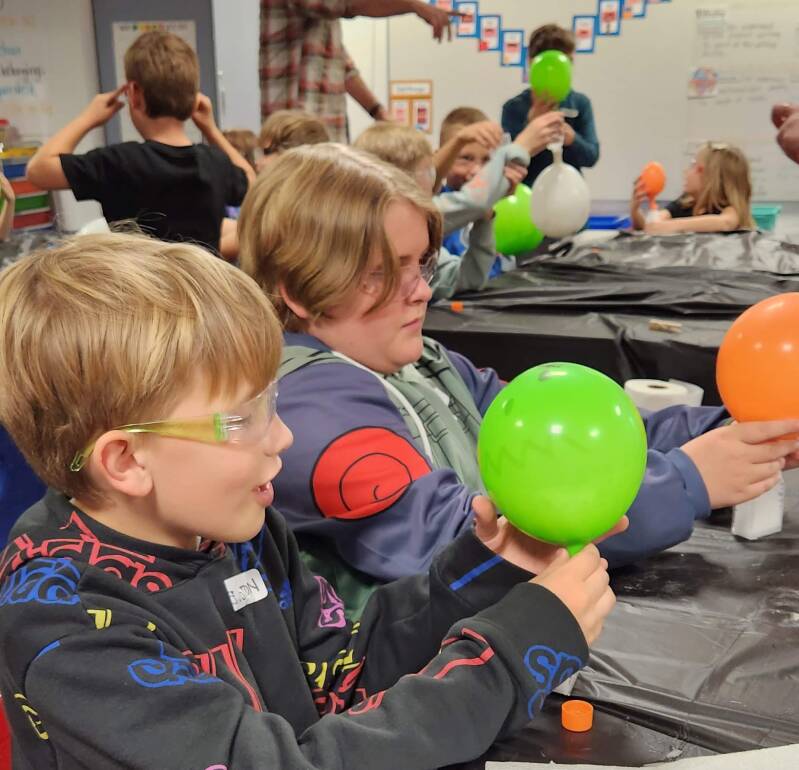
Success Is Not a Perfect Result
When an activity works exactly as expected, students see a scientific idea made visible and gain experience following a procedure. But they often practice more scientific thinking when it doesn't work. An unexpected result asks kids to observe carefully, separate evidence from assumptions, and decide what to do next. It shows them that science is not a collection of perfect answers produced by people who never make mistakes. It's a process of asking questions, gathering evidence, revising ideas, and trying again.
The goal is not to convince students that failure always feels good (because it doesn't). The goal is to show them that a disappointing result does not mean they are bad at science or that the learning has ended. Sometimes the moment when an experiment “fails” is the moment a student stops following directions and begins thinking like a scientist.