

If you’re like me, it’s only the first week of June and your kids have already consumed enough screen time for the entire summer. We’ve slept in, lounged around, beat Super Mario Odyssey, and now the kids are “bored.”
Enter my arsenal of simple science activities that are perfect for summertime.
Summer is one of my favorite times to share science with my kids because there are so many easy ways to explore STEM without setting up a formal experiment. Kids can observe plants growing in the garden, test what floats in the pool, notice how their shadows change throughout the day, or wonder why ice cream melts so quickly in the sun. And all without screens.
Once you start looking, summer is full of scientific connections. Heat, sunlight, water, weather, insects, plants, bubbles, and backyard discoveries all give kids chances to ask questions, make predictions, test ideas, and observe the world around them.
That is why I love simple summer science activities. They keep kids busy, but they also help kids see that science is not just something that happens in a classroom or lab. Science is happening all around them, even on a slow summer afternoon.
Here are six low-prep summer science activities you can do at home, in the backyard, at the park, or anywhere your kids need something fun and screen-free to try.
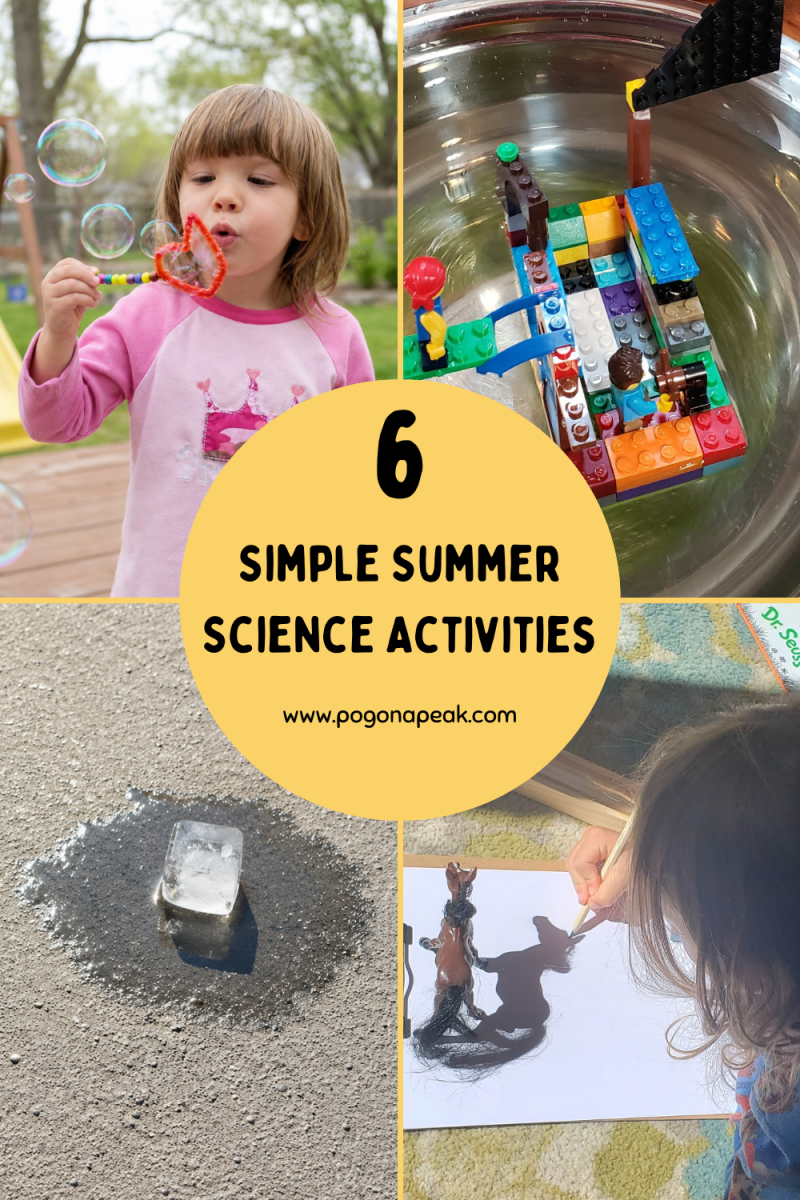
1. Shadow Watch
This is one of the easiest summer science activities because you do not need any special supplies. All you need is sunlight, an object, and a place where kids can observe a shadow.
Have your child choose something that makes a clear shadow. This could be a toy, a stick, a water bottle, a plant, or even their own body. Mark or trace the shadow in the morning, then come back later in the day and mark it again.
Ask:
- Did the shadow move?
- Did it get longer or shorter?
- Did the direction change?
- When do you think the shadow will be shortest?
The science behind it
Shadows change throughout the day because Earth is rotating. As the Sun appears to move across the sky, the angle of the light changes. When the Sun is lower in the sky, shadows are longer. When the Sun is higher in the sky, shadows are shorter.
This activity is simple, but it helps kids practice a major science skill: noticing change over time.
Make it more fun
Have kids turn it into a shadow investigation. They can trace their shadow every hour, compare shadows from different objects, or try to predict where the shadow will be later in the day.
Older kids can measure shadow length and make a simple chart. My kids took it a step further and started mapping the shadow a tree makes over our plot in the school garden to calculate how many hours of sun different plants got. Spoiler, they only got about 2 hours of sun which is why most of them didn’t grow well.

2. Ice in Sun vs. Shade
This is a perfect hot-weather activity because it uses something kids already understand: ice melts. But with one small change, it becomes a real science investigation.
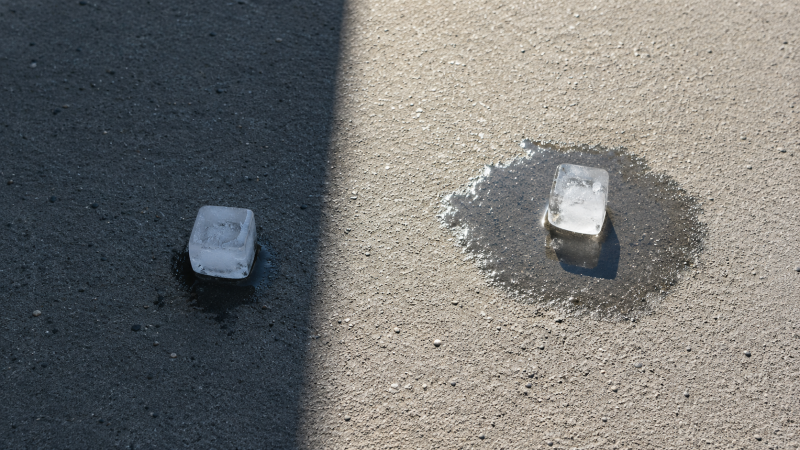
Place one ice cube in the sun and one ice cube in the shade. Before starting, ask your child to predict which one will melt faster. Then watch what happens.
You can keep it very simple, or you can use a timer and record how long each ice cube takes to melt.
The science behind it
This activity introduces heat, sunlight, melting, and variables. The ice in the sun usually melts faster because it is receiving more energy from sunlight. That energy breaks the bonds that keep the ice in solid form. The ice in the shade is protected from direct sunlight, and receives less energy, so it often melts more slowly.
This is also a great way to introduce the idea of a fair test. If you are comparing sun and shade, try to keep the ice cubes the same size and place them on similar surfaces.
Make it more fun
Try placing ice cubes on different surfaces, such as grass, pavement, foil, a plate, or a dark piece of paper. Which surface makes the ice melt fastest? Which one helps it last longer?
Kids can also test whether adding salt changes how quickly ice melts.
3. Bubble Wand Challenge
Bubbles are a classic summer activity, but they are also full of science.
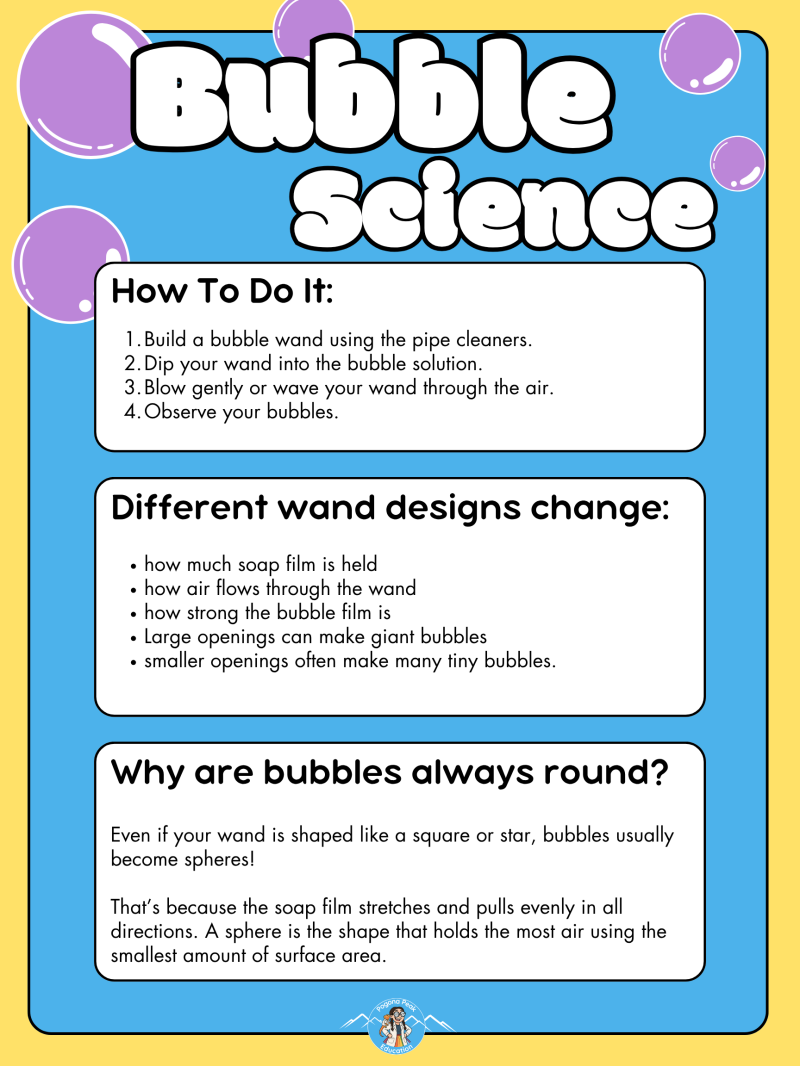
For this activity, challenge your child to design their own bubble wand. Pipe cleaners work well, and kids can bend them into different shapes. They can also try straws and string, wire, or other flexible materials you have around the house.
When I have tested bubble wands, I have found that the rough glittery pipe cleaners tend to work better than the soft fuzzy ones. The very fuzzy pipe cleaners can sometimes hold too much bubble solution or make it harder for a smooth bubble film to form.
Have kids test different wand shapes:
- Circle
- Square
- Triangle
- Heart
- Star
- Long oval
- A totally made-up shape
Then ask: Do different-shaped wands make different-shaped bubbles?
The science behind it
Bubbles form because of surface tension. A bubble is a thin film of soapy water wrapped around air. Even when the wand is shaped like a square or triangle, bubbles usually become round once they float away because a sphere is the shape that uses the least surface area to hold the air inside.
That means kids may design all kinds of wild bubble wands and still discover that free-floating bubbles are usually round.
Make it more fun
Download my free printable and turn it into a design challenge. Ask your child to build a wand that can make:
- The biggest bubble
- The most bubbles at once
- The longest-lasting bubble
- The strangest bubble shape before it floats away
This is a great chance to remind kids that scientists and engineers often test, adjust, and try again.

4. Mini Boat Challenge
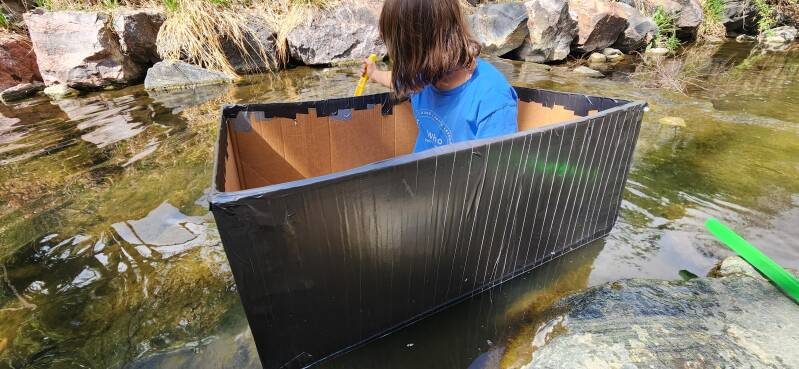
During covid, our local used-lego store hosted a number of virtual lego building challenges and one of them was to create a boat that floats. Boy, oh boy, did that challenge keep my kids busy for a LONG TIME. They made big boats and tiny boats and boats that held stuffies and rocks. They moved from lego to cardboard and popsicle sticks and foil… the options are limitless! The mini boat challenge is a simple engineering activity and you only need a container of water and a few building materials.
Kids can build boats out of aluminum foil, recycled containers, craft sticks, paper, plastic lids, or interlocking bricks (like Lego).
Once the boat is built, place it in water and test how much weight it can hold before it sinks. Pennies, small rocks, buttons, or small toys all work well as cargo.
Ask:
- Does your boat float?
- How much weight can it hold?
- Where should the weight go?
- What would you change next time?
The science behind it
This activity helps kids explore floating, sinking, buoyancy, weight, and balance. A boat floats when it pushes enough water out of the way to support its weight. The shape of the boat matters because it affects how the weight is spread out.
If all the cargo is placed on one side, the boat may tip. If the weight is spread out, the boat may stay balanced longer.
Make it more fun
After the first test, give kids time to redesign their boat. This is the most important part. The goal is not to build a perfect boat on the first try. The goal is to test, notice what happened, improve the design, and test again.
You can also add challenges:
- Build a boat that holds 10 pennies.
- Build a boat using only one material.
- Build the smallest boat that can still float.
- Build a boat that can survive “waves” made by gently blowing on the water.

5. Capillary Action
I love doing this capillary action activity because it helps kids (and grown-ups) visualize what is normally a hidden process. Plants may look like they are just sitting there, but they are constantly moving water. Every leaf, stem, and flower depends on water traveling from one part of the plant to another and this is one way to see it.
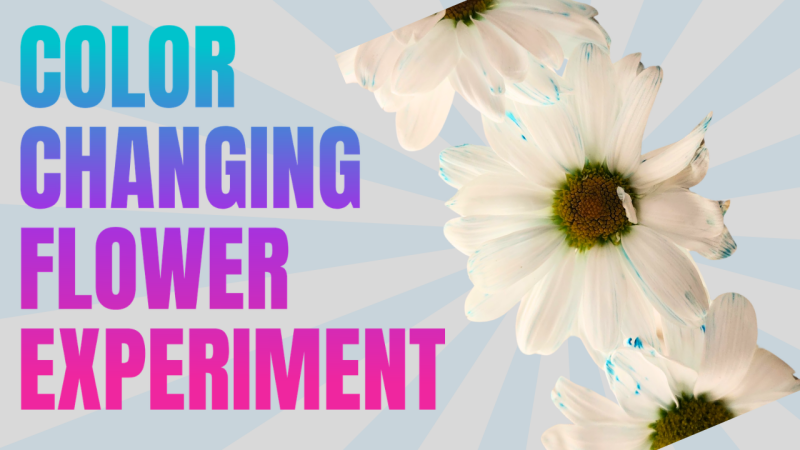
You can do this with white flowers, celery, romaine lettuce, or even paper towels. Place the plant stem or paper towel into a cup of colored water and observe what happens over time.
White flowers often show the color beautifully, but can sometimes take a day or two to show any results. I prefer celery and romaine because it happens faster, plus kids can see the colored water moving through the veins. Check out my video on doing this with romaine versus flowers.
Ask:
- Where do you see the color first?
- Does the color move quickly or slowly?
- What do you think is carrying the color?
- What might happen if we use a different color?
The science behind it
Capillary action is the movement of water through tiny spaces. In plants, water moves upward through narrow tubes and then evaporates through the leaves, constantly pulling new water through the plant. This helps plants move nutrients in the water from their roots to their stems, leaves, and flowers. By adding food coloring to the water, the color moves with the water, making it easier to see where the water travels.
Make it more fun
Try comparing different plants or different colors. Test if warm water or cold water moves faster. You can also split the stem of a white flower and place each side into a different color of water. Kids can observe whether the flower shows both colors.
Older kids can record observations every hour and compare how quickly different plants take up water.
6. Pollinator Count
This is a quieter activity, but it is one of my favorite ways to help kids slow down and really observe the world around them.
Find a flowering plant in a garden, yard, park, or sidewalk area. Set a timer for 5–10 minutes and count how many pollinators visit the flowers.
Kids can look for:
- Bees
- Butterflies
- Flies
- Beetles
- Moths
- Hummingbirds, depending on where you live
Remind kids to watch without touching. Pollinators are busy doing important work, and the goal is to observe them safely.
The science behind it
Pollinators help move pollen from flower to flower. This allows many plants to make seeds and fruit. Bees and butterflies are the pollinators kids often know best, but flies, beetles, moths, birds, and even some bats can also be pollinators.
This activity builds observation skills and helps kids notice biodiversity. They may be surprised by how many different animals visit the same patch of flowers.
Make it more fun
Repeat the pollinator count at different times of day. Are there more visitors in the morning, afternoon, or evening?
You can also compare different flowers. Do pollinators seem to prefer certain colors, shapes, or locations?
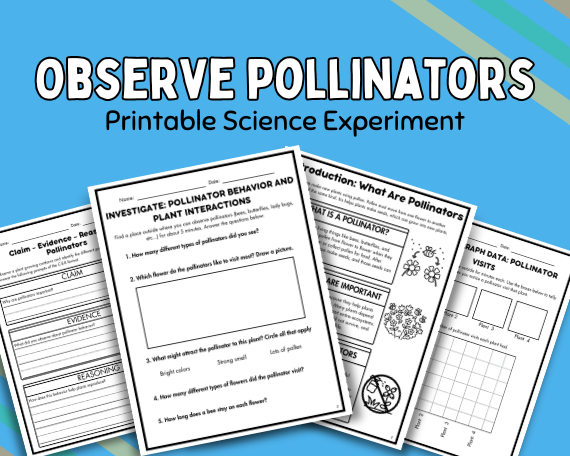
For older kids, have them make a simple data table with columns for time, weather, flower type, and number of pollinator visits. You can you my FREE pollinator tracking sheets and questions!

Simple Science Counts
Science does not have to be complicated to be meaningful. These activities may look simple, but they help kids practice real science skills:
- Asking questions
- Making predictions
- Observing closely
- Testing ideas
- Measuring and counting
- Comparing results
- Redesigning and trying again
Younger kids can focus on noticing and describing what they see. Older kids can measure, record data, make charts, and design their own follow-up experiments. These activities feel like play. In fact, some of these activities are ones I did with my own kids for fun before I even relaunched my science education business. Kids get to chase shadows, melt ice, blow bubbles, build boats, color flowers, and watch bugs while building the habits of curious scientific thinkers. These are habits that will serve them well in the future as I described in a previous blog post.
Want More Easy Summer Science Ideas?
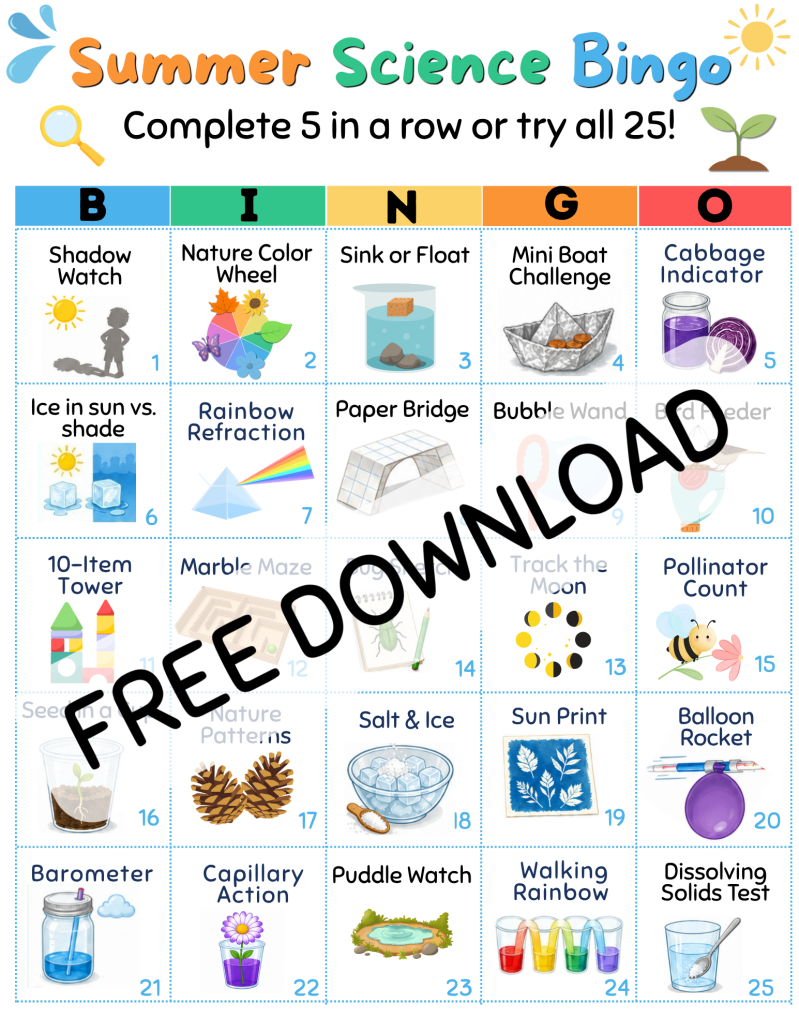
These six activities are just a few of the challenges included in my free Summer Science Bingo Activity Pack. And it is more than just a bingo card.
Inside the pack, you will get a printable bingo card with 25 simple summer science challenges, plus activity pages with basic procedures, supply ideas, and extension activities. That means you can use each square as a quick boredom-buster or turn it into a deeper hands-on investigation.
Use it when the kids are bored, when you need a screen-free activity, or when you want an easy way to keep curiosity alive all summer long.
If you get a bingo (5 in a row horizontally, vertically, or diagonally) post it on social media and tag me to be entered into a prize drawing for a few different prizes including a Summer STEM Activity Box, a copy of Would You Rather... Science Edition, or a copy of STEM Riddles and Brain Games.
Add comment
Comments