


My family does Pizza Friday every week, and we take turns choosing the TV show/movie to watch while we eat our pizza. My husband and I (who are unapologetic PBS nerds) picked an episode of NOVA The Fabric of the Cosmos: The Illusion of Time (season 38 episode 17) and my middle-schooler became enthralled with the idea of spacetime.
When her science teacher assigned an end-of-year passion project, she knew right away that she wanted to share her love of spacetime with her classmates, so we set out on the search for a hands-on project she could make. Funnily enough, that same week, a science fair student of mine asked me to help her find a project that would involve Einstein’s theory of relativity. As I searched high and low for different experiments for both of them, I stumbled across this simple demonstration that ended up solving both problems at once.
Words like spacetime, curvature, and general relativity can feel too abstract for kids to picture. But with a simple stretchy fabric model, a heavy ball, and a marble, kids can begin to visualize that gravity is not only about objects pulling on each other, but also about how massive objects bend the spacetime around them.
This hands-on STEM demonstration is a great way to introduce kids to gravity, motion, orbits, and the idea that objects with mass can change the space around them.
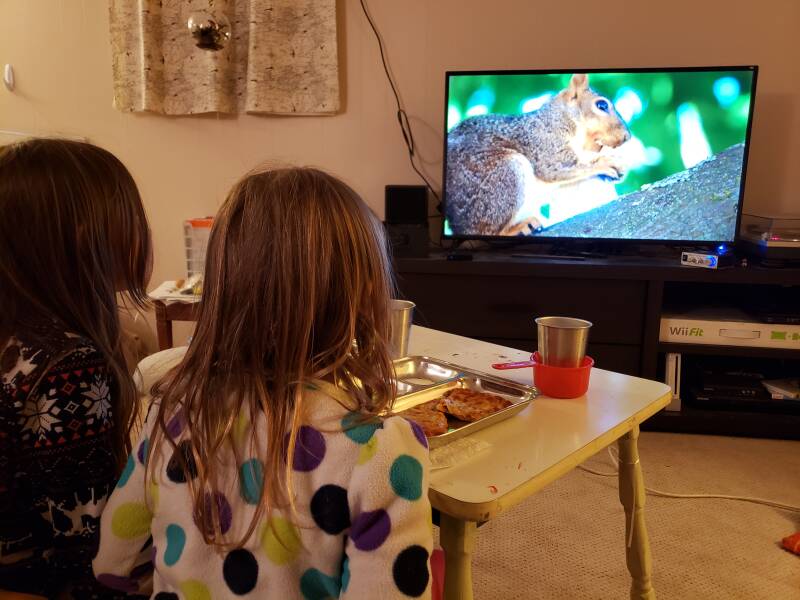
A photo of Pizza Friday: watching the PBS Nature episode on squirrels. A Squirrel's Guide to Success. Season 37, episode 4.
What Is Spacetime?
Before Einstein, people often thought of space and time as separate things. Space was where objects existed, and time was something that ticked forward in the background. Einstein’s Theory of Relativity changed that idea. He showed that space and time are connected in something called spacetime. A helpful way to picture spacetime is to imagine a stretchy fabric. This fabric represents the space around objects and helps us visualize something that is otherwise very hard to see.
How to Make This Gravity Model
For this simple relativity demonstration, you need:
- A stretchy piece of fabric, such as spandex. We used 80% nylon and 20% spandex.
- A large bowl, bucket, or frame to stretch the fabric over.
- A marble or small ball.
- A heavy ball, such as a rubber ball, weighted ball, or large smooth object. We used 2-inch boading balls.
Step 1: Assemble the Spacetime Model
Stretch the fabric tightly over the bowl or frame. The fabric should be firm enough that a marble can roll across it, but stretchy enough to dip down when you place a heavy ball in the middle. Secure the fabric in place using a strong rubber band, bungee cord, or clothes pins.

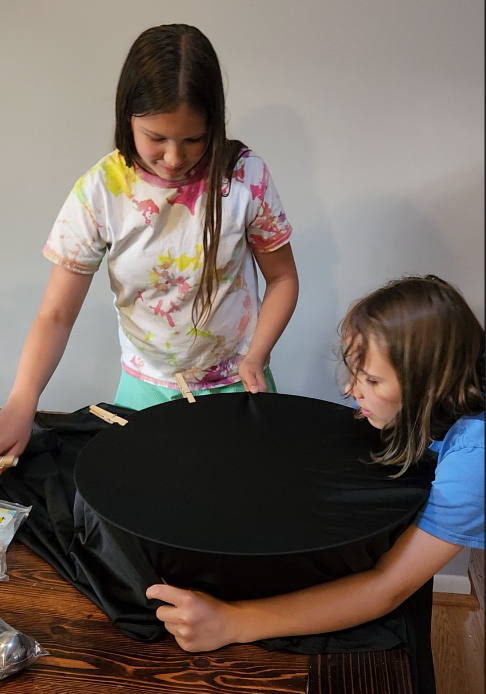
Step 2: Rolling a Marble Across Flat Spacetime
Roll a marble across the stretched fabric without anything heavy in the center.
When the fabric is flat, the marble moves in a fairly straight path. This represents an object moving through space when there is not a large mass nearby changing its path.
In real space, an object will keep moving in a straight line unless something changes its motion. This connects to Newton’s First Law of Motion, but it also helps set up the idea of what happens when spacetime is curved.


Step 3: Adding a Heavy Ball to Curve the Fabric
Next, place a heavy ball in the middle of the fabric.
The fabric bends downward around the ball. In this model, the heavy ball represents a massive object, such as a planet, star, or black hole. The dip in the fabric represents the way mass curves spacetime.
Now roll the marble across the fabric again.
Instead of moving in a straight line, the marble curves toward the heavy ball. It may spiral around it, orbit for a short time, or fall into the dip.
This helps kids see how a massive object can change the path of another object moving nearby.
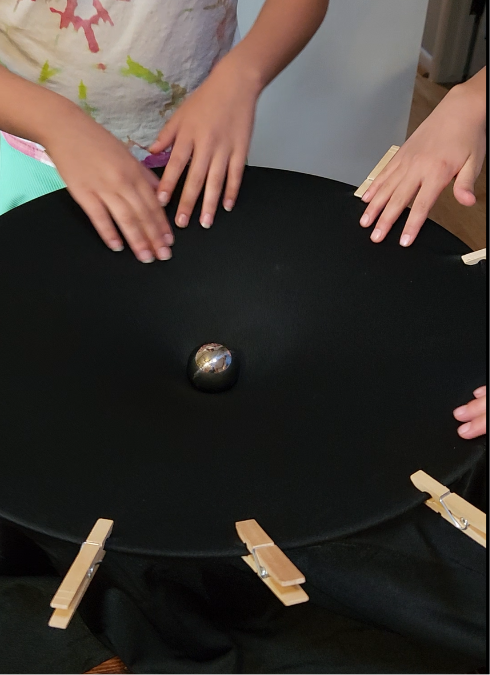

How This Demonstrates Gravity
Einstein’s Theory of General Relativity explains gravity as the curvature of spacetime caused by mass. The more massive an object is, the more it curves spacetime. Objects moving nearby follow paths through that curved spacetime. That is why planets orbit the Sun. The Sun has a lot of mass, so it curves spacetime around it. Earth is moving forward through space, but because spacetime is curved around the Sun, Earth follows a curved path (an orbit).
In our model:
- The fabric represents spacetime.
- The heavy ball represents a massive object like the sun.
- The dip in the fabric represents curved spacetime.
- The marble represents an object moving through space like Earth.
- The marble’s curved path shows how gravity changes motion.
When the marble rolls near the heavy ball, it does not continue in a straight path because the surface beneath it is curved. The marble follows the shape of the fabric.
This is the main idea kids can take away from the demonstration: massive objects can change the path of moving objects. Gravity is not just something pulling objects down. In Einstein’s view, gravity is connected to the shape of spacetime itself.
How This Can Demonstrate Black Holes
This model can also be used to show how black holes work. Black holes are not cosmic vacuum cleaners. They are regions where spacetime is curved so strongly that, past a certain point, nothing can escape (not even light). A black hole would be like an object so massive and compact that it makes an extremely deep, steep curve in spacetime.
In the fabric model, you could imagine replacing the heavy ball with something much denser that creates a much sharper dip. A marble that gets too close would spiral inward and would not be able to roll back out. That “point of no return” is called the event horizon. In the fabric model, you might describe it as the area where the marble is too close to the deep dip to escape. Once it crosses that boundary, it keeps moving inward.

Questions to Ask Kids During the Activity
Try asking kids questions as they observe the model:
- What happened when the marble rolled across the flat fabric?
- What changed when we added the heavy ball?
- How did the marble’s path change?
- What do you think would happen if we used a heavier ball?
- What do you think would happen if we rolled the marble faster?
- How is this model like real gravity?
- How is this model different from real space?
These questions encourage kids to make observations, compare results, and think like scientists.
Extension Ideas
You can turn this demonstration into a mini investigation by changing one variable at a time.
Try testing:
- A heavier ball versus a lighter ball
- A faster marble versus a slower marble
- A larger marble versus a smaller marble
- Tighter fabric versus looser fabric
- Different starting positions for the marble
Kids can predict what will happen, test their ideas, and observe how the marble’s path changes.
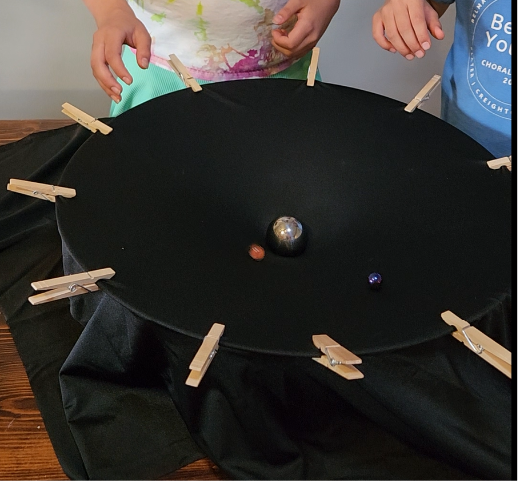
Flaws With This Model
No model is perfect, and this one has some important limitations.
Real spacetime is not a flat sheet. It is three-dimensional space connected with time, which is much harder to model. In this demonstration, the marble is also affected by Earth’s gravity as well as friction as it rolls across the fabric. That means the model is not exactly the same as what happens in space.
But even though it is not perfect, it is still useful. This fabric model gives kids a visual way to understand a difficult idea: mass changes the shape of spacetime, and that curved spacetime changes how objects move and how gravity behaves.
The Big Idea
Einstein’s Theory of Relativity can be challenging, but kids do not need to understand all the math to begin exploring the concept. With a simple spacetime model, they can see that massive objects bend the space around them and that moving objects follow curved paths through that space. This activity is a fun, hands-on way to introduce kids to gravity, orbits, spacetime, and one of the most important scientific ideas in modern physics.
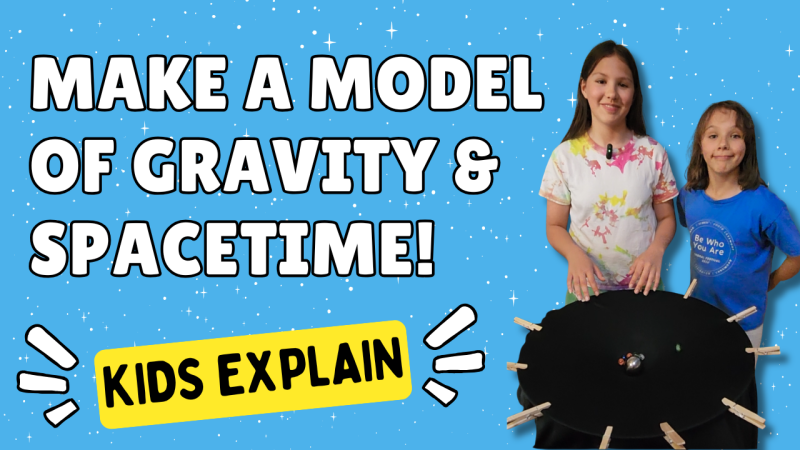
If you’re interested in seeing my middle-schooler (and sister) present her model, you can check it out here.
Add comment
Comments